Press reactions
International media’s takes on the failure of COP31


Jitendra Choubey, Indian Express, India: “COP-out: No deal on Earth”
“Organised under twin presidencies of Turkiye and Australia, both fossil fuel-producing nations, a major failure of COP31 was political responsibility. Developed nations, including the EU, the UK, and Japan, resisted making measurable commitments to fund climate action. Conversely, major fossil fuel-producing countries such as Saudi Arabia and Russia opposed stronger language on transition away from oil, gas, and coal.
As a result, the draft text included provisions for an electrification goal and carbon capture but did not feature strong commitments against fossil fuels or public financing required by developing nations. Its main aspiration was large-scale deployment of carbon capture by 2035, with no emission-cut commitments.
That is a step back from COP28, three years ago in Dubai, when countries agreed to transition away from fossil fuels. (…)”
https://www.newindianexpress.com/india/2026/Nov/23/cop-out-no-deal-on-earth
Lilys Njeru and Zeynab Wandati, Daily Nation, Kenya: “COP31 talks collapse without deal as clashes cloud talks”
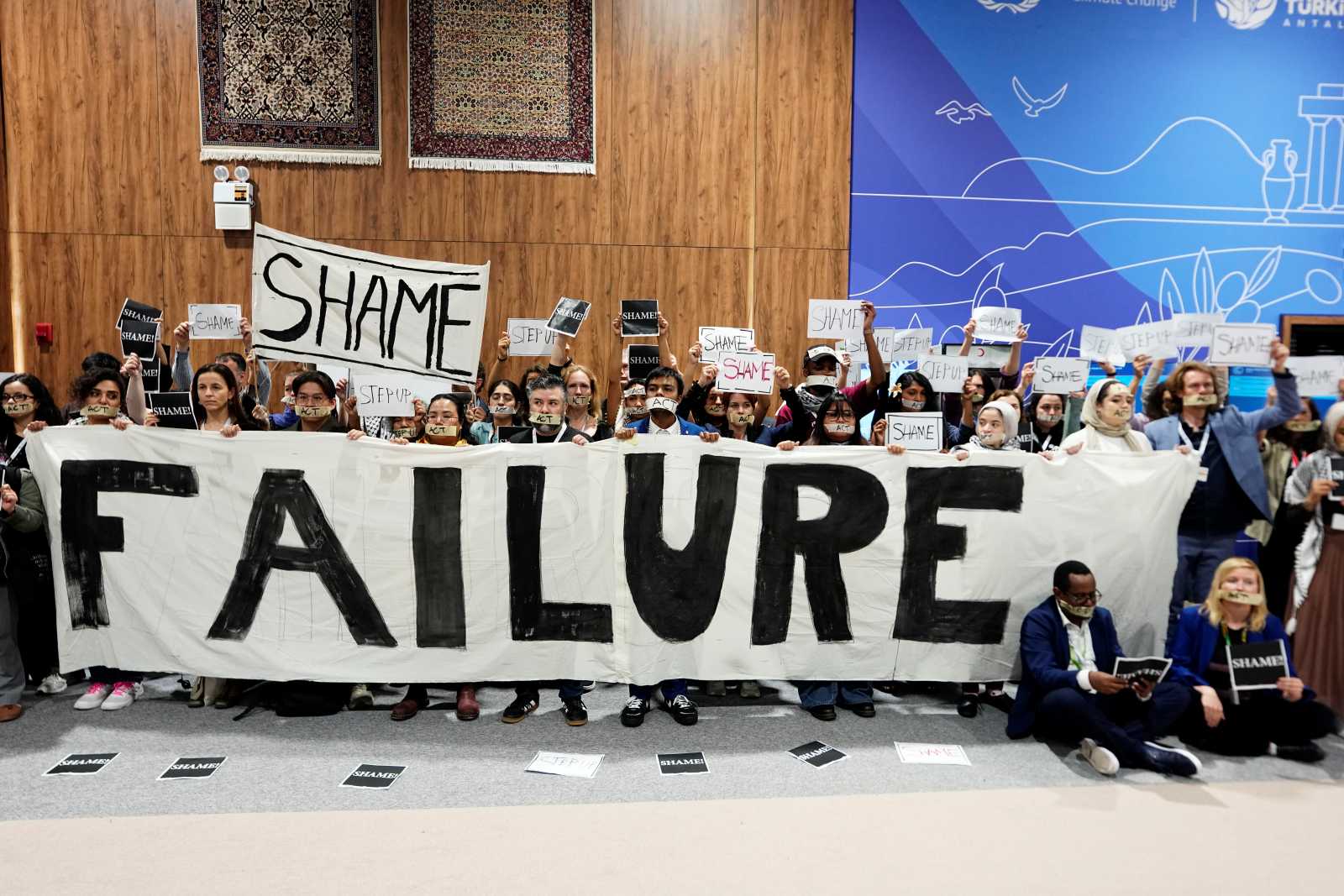
“As talks spilled into overtime, frustration boiled over inside and outside the plenary halls. Activists staged silent protests outside the plenary and held signs reading “SHAME!” inside the hall, with at least one protester removed during closing proceedings, while ministers clashed over procedure and perceived disrespect. African delegates voiced anger at being sidelined during late-night huddles, and Ghana’s Environment Minister Zanetor Agyeman-Rawlings was interrupted while she was speaking, which upset the African Group further. (…)
The no-deal outcome leaves unresolved mandates on fossil fuels, adaptation finance, and a just transition mechanism hanging over the UN process as the presidency passes to Ethiopia for COP32 in Addis Ababa in November 2027. As Adow [editor’s note: Mohamed Adow, director of Nairobi-based think tank Power Shift Africa] warned, “It’s a crying shame that the mess left over by Türkiye and Australia is left to Africa to sort out. Hopefully, a COP held on the front line of the climate crisis will focus minds.””
Michael Bauchmüller, Süddeutsche Zeitung, Germany: “Europe says no”
“This climate summit was a setback for the world. (…) Countries such as Saudi Arabia and Russia, which use billions from fossil fuels to build skyscrapers or wage wars, threw so much sand in the United Nations’ works in Antalya that the machinery of international climate diplomacy eventually ground to a halt. The conference chairs, a peculiar Turkish-Australian duo, let it happen. (…)
Whether a climate conference brings progress, or – as in Antalya – the exact opposite, is decided in the period between conferences – in the diplomatic preparations, in the work on solutions, and in the trust that develops between states beyond the conference setting. The fact that Germans, Europeans and others have recently been keen to cut development aid has certainly not helped to build trust.
But there is good news from Antalya. Oil-rich countries have moved heaven and earth to prevent the conference from making progress. Had they not feared the Paris Agreement, they could have spared themselves this effort. Instead, Antalya became the scene of a struggle for survival, in which a handful of states sought to defend destructive business models. The Europeans and threatened island states have said a resounding “no”. And rightly so.”
https://www.sueddeutsche.de/meinung/klimakonferenz-antalya-scheitern-cop31-kommentar-li.3583704?reduced=true (Paywall) (in German)
Bill Hare, The Guardian, Great Britain: “The good news out of Cop31? That most of the world’s governments said no to an agreement stripped of meaning”
“The failure of Cop31 in Antalya was a line in the sand moment, a victory for multilateralism as countries stood up to the big fossil fuel producers and said no. The text they rejected barely recognised the catastrophic climate emergency we’re facing, let alone signalled a definitive move away from fossil fuels.
The good news is that most of the world’s governments rejected an agreement stripped of meaning. And the power of one particular fossil fuel producer, Saudi Arabia, needs particular scrutiny. What we also know is that co-chairing global climate talks is clearly not something to be repeated, certainly not by Australia. It didn’t work.”
https://www.theguardian.com/environment/commentisfree/2026/nov/23/cop31-climate-summit-no-agreement
Sopuruchi Onwuka, Daily Champion, Nigeria: “COP31: Turkiye Climate Conference ends in deal impasse”
“Nigeria and some other developing countries stand at the crossroads of the climate impasse, receiving the harsh climate impact on the one hand while relying on fossil energy as critical revenue and energy source to finance energy transition, economic growth, climate resilience and energy security. (…)
Oil-producing countries, including Nigeria, Saudi Arabia and Russia, resisted stricter language on fossil fuels, arguing that the negotiations should focus on emissions reduction rather than prescribing the elimination of specific energy sources. (…)
Despite the failure of the Antalya Pact, the conference was not without progress, as several countries and coalitions recorded gains through side agreements, voluntary commitments, partnerships and sector-specific initiatives aimed at cutting emissions, expanding clean energy, strengthening climate resilience and mobilising finance. (…)
The summit’s outcome exposed the limits of climate diplomacy built around unanimity, with industrialised nations demanding stronger fossil fuel commitments, developing countries insisting on equity and financing, and oil-producing states defending their energy and economic interests.”
https://championnews.com.ng/cop31-turkiye-climate-conference-ends-in-deal-impasse/
La Jornada, Mexico: “COP31: Self-destructive disagreements”
“The conflict is far more complex than a mere dichotomy between the global North and South, or between producers and consumers of hydrocarbons. It relates to the diversity of energy mixes across regions and countries, the pace at which they intend to modify these mixes to transition towards clean energy, the controversial issue of “carbon capture”, and the funding required for this transition. (…)
However, not all national economies can cope with the enormous investments required to transition to electricity generation based on less polluting technologies, the widespread adoption of electric vehicles, the reforestation of large areas, or the widespread adoption of systems for cleaning and recycling industrial emissions, amongst many other necessary measures. Whilst for most European countries, photovoltaic, wind or nuclear power generation is ultimately cheaper than the use of imported hydrocarbons, for other nations such a transition entails a financial burden that is difficult or impossible to bear. (…)
The truth is that, regardless of national responsibilities, this phenomenon [of climate change] has disastrous consequences for humanity as a whole, and no country is immune to them. From this perspective, the failure to reach a global agreement is tantamount to suicide.”
https://www.jornada.com.mx/noticia/2026/11/23/editorial/cop31-desacuerdos-suicidas (in Spanish)
Manuel Planelles, El País, Spain: “Climate summit fails, unable to reach an agreement that singles out fossil fuels”
“Lower-income countries, led by the African Group, have been pushing for the final agreement at this COP31 to include a specific figure [for adaptation funds mobilised by developed countries]. This was something the EU did not even want to hear about. Even less so at a time when the far-right tide is rising, with elections on the horizon in France and Spain, and when talk of development aid is grist to the mill for the far right. During the plenary session, the group of African countries and India lashed out at the EU for failing to make progress on funding and to “assume its responsibilities”. China has shown its support for both blocs in their demands. (…)
Just as important as what was happening inside the COP was what was happening outside. Thousands of kilometres from Antalya, in the Chinese city of Shenzhen, the leaders of the US, Russia and China agreed at the end of last week to increase oil production at their historic three-way meeting.
The D+C editorial team
euz.editor@dandc.eu