Community organisations
For poor communities in Kenya, football is more than just a game


NGUVU Edu Sport (“NGUVU” means “power” in Kiswahili) exemplifies how the role of small grassroots projects is changing – and how their burden keeps growing. It began by focusing on football, mentorship and educational support, but the local community’s mounting hardships and growing despair have prompted the organisation to expand its services. Today, NGUVU also helps cover basic necessities such as food, housing and medical care.
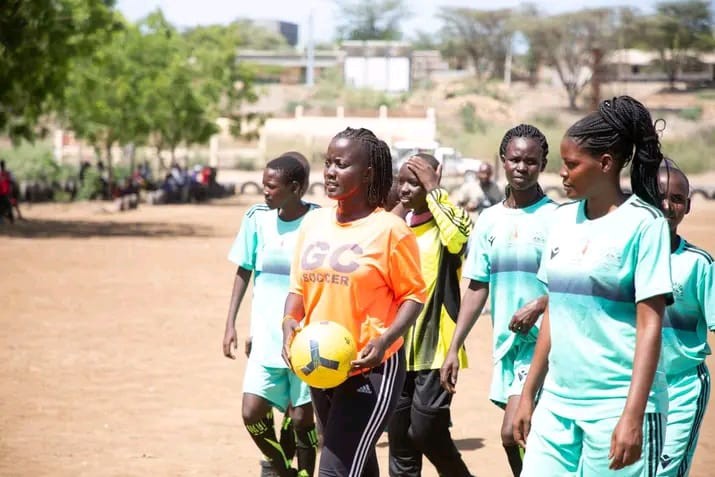
Founded 12 years ago in Juja, a city in the Nairobi metropolitan area, the project initially offered talented but vulnerable boys a place to play football. From the outset, it also aimed to foster values such as self-confidence, respect and tolerance. Later, NGUVU formed a girls’ team and expanded to include other activities, such as dance.
As hardship grew amid extreme weather events and the global economic downturn after the Covid-19 pandemic, NGUVU adopted a more comprehensive approach. The donation-funded project began supporting not only the children in its teams but also their families – helping them pay rent, cover medical bills or put food on the table in times of need.
This is why football has always been more than just a sport for the beneficiaries of this community-based organisation: it has offered them a path to education, stability and new opportunities.
Education and sports
Susan Naboi remembers how difficult and uncertain life was before she joined the organisation. School fees, uniforms and even basic learning materials were often unaffordable. “Sometimes I had to go to school on an empty stomach, and yet I was still expected to achieve excellent academic results,” she recalls. She adds that there were hardly any opportunities after school to play football or get together with peers in a safe environment.
As a South Sudanese refugee, Susan could not be sure that she would be able to complete her education. Thanks to NGUVU, however, she now sees new prospects for her future. Susan is studying sports science at the country’s largest university, while also playing for the university’s women’s football team and the NGUVU girls’ team.
John Eketo plays as a goalkeeper for the boys’ team, NGUVU Homeboyz FC. He grew up in a single-parent household and watched his mother struggle to raise him and his siblings on her own. She found it a constant challenge to pay their school fees and cover basic necessities, and he often felt uncertain about his chances of continuing his education.
With the organisation’s support, however, he has been able to pursue his studies without interruption. “Being part of this programme is a privilege for me,” he says. John is currently completing a diploma in electrical engineering and hopes to secure employment or start his own business once he finishes his studies.
Football still plays a central role in his life. The NGUVU Homeboyz train four times a week, and most Sundays they play a match. These days, the team competes in Kenya’s third-highest league and is a source of pride for the whole town – very few teams from the area have ever made it that far.
On match days, crowds gather at the sandy pitch on the edge of town, which turns into a muddy field when it rains. People from all over Juja come to watch, and for away games, anyone who can manage the cost tries to travel along.
Football means safety
“Juja has a high crime rate,” says the project’s head coach Fredrick Owuor, who grew up in the town, as did the other three coaches. “Football here is not just a sport or a pastime. It keeps young people on the pitch instead of out on the streets, where they might come into contact with drugs, become victims of crime or – driven by poverty – end up turning to crime themselves.”
When they are training or playing matches, his boys are safe, he adds. The programme also gives these young men structure and a sense of belonging in a daily life that otherwise offers few prospects for many of them.
This is even more true for girls. In Juja, teenage pregnancies are common, especially in vulnerable families, and young mothers have little chance of escaping the cycle of poverty. This is why it is particularly important for young women to have safe spaces in which to exercise and connect. Such opportunities can be critical for building self-confidence, navigating social pressures and staying in school.
Because of the “mzungu”?
During league matches, the NGUVU Homeboyz often hear from other teams that they have only got this far “because of the mzungu”. In East Africa, “mzungu” is a collective term for white people. The reference is to Lothar Firlej, a former coach with the German Football Association (DFB) and a sports teacher from Germany. He founded NGUVU Edu Sport after spending some time working for a Catholic religious order in Kenya.
Firlej merely smiles at such allegations: “It’s the boys who have to play, after all.” For the 64-year-old, results are not what matters most. “The programme is also about teaching young people important values they will need for their future – teamwork, respect, a sense of responsibility and discipline.”
In addition to the sports programme, NGUVU regularly offers workshops led by the coaches or external facilitators for children and young people – for example on violence prevention, gender roles, responsible media use or first aid.
Stepping in where the state is absent
NGUVU is an example of how grassroots sports initiatives can contribute to broader development goals. By helping young people to stay in school, such programmes improve their future employment prospects and economic opportunities. Across Kenya, similar local initiatives are quietly taking on tasks that go far beyond talent development. They fill gaps in the public social welfare system, particularly in areas with many low-income households.
In this context, football is becoming a pathway to social protection where the state is absent. For young people like Susan and John, it is largely community organisations that step in to provide essential support such as help with education, medical care or nutrition – services that should be the responsibility of the state. For a range of reasons, including resource mismanagement and high debt-servicing costs, it often fails to do so. In places like Juja, the blend of sport and social work therefore fills gaps that families and public institutions struggle to address on their own.
NGUVU is just one of many organisations in Kenya that work in similar ways. Today, the programme supports more than 80 young players across three teams as well as, to a lesser extent, their siblings and other family members, bringing the total number of young people receiving support to over 300. In addition, 200 older people take part in a fortnightly programme for senior citizens that was launched three years ago. However, maintaining this model remains an ongoing challenge.
It is not surprising therefore, that many grassroots sports initiatives are founded or run by Westerners, as local communities often lack the financial capacity to maintain such programmes. While successful Kenyan initiatives do exist too, they tend to work in a less holistic way. Many programmes rely on donations from and partnerships with Europe or the US, which are often easier to secure when a founding member already has established personal connections.
For NGUVU, as for many other grassroots initiatives, the growing uncertainty surrounding funding is limiting both the number of beneficiaries and the continuity of the support that can be provided. “The need is growing, but resources have tended to dwindle in recent years,” says Firlej. As a result, the project has to make increasingly difficult decisions about who to support. “People in the community know what we do, and requests from families not yet in the programme have been endless since we decided to no longer focus only on football,” he adds.
This highlights a key tension: while community organisations can be flexible and responsive, they cannot replace the scale and stability of public systems. Still, Firlej does not regret expanding the sports project to include support for basic needs: “It’s clear that you also have to focus on the bigger picture – nobody can play football on an empty stomach.”
Link
NGUVU Edu SPORT
Alba Nakuwa is a South Sudanese freelance journalist based in Nairobi, Kenya. She works part-time as a coach for the NGUVU girls’ team.
albanakwa@gmail.com