Water
Struggle for water

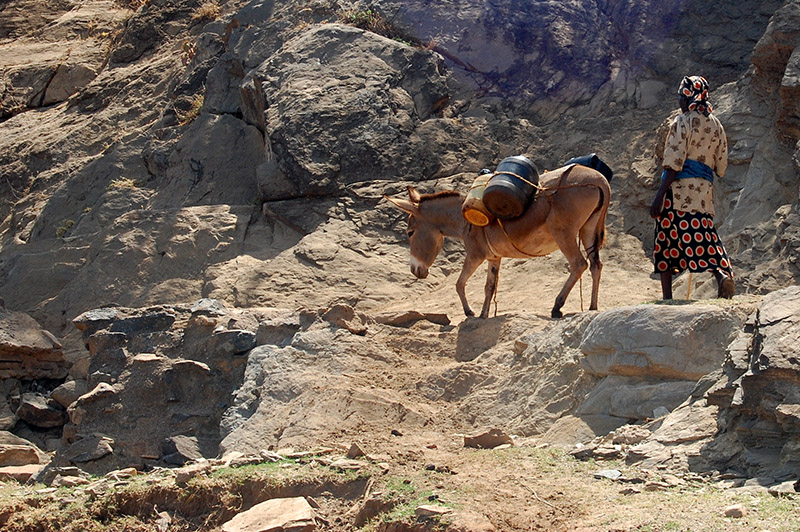
In many rural areas in Togo, women and children walking along roads and paths with large containers are a common sight. Normally, they are fetching water for household use. Clean water is quite a luxury for many people. According to UNICEF, a quarter of Togo’s people do not have access to drinking water within 30 minutes walking distance.
In Tchangana-Kondji village, almost 300 km north of Lomé, the capital city, the single well is nearly dry. It was built by Germans in 1978. The queues are long, but every person in the line only gets a small bucket of water. Many people get their drinking water from a nearby river. Its water is muddy, dirty and disease-carrying. “The water people drink in this village should neither be used for bathing nor given to animals,” says Nourroudine Kolani, a volunteer with the civil-society organisation LIFE NGO.
According to the German Red Cross (GRC), people die of hygiene-related illnesses, including cholera, typhoid and other water-born diseases. In cooperation with the Togolese Red Cross and Togo’s government, the GRC drilled new wells or repaired old ones to improve water supply in 60 villages in recent years. The project was funded by the EU.
In M’bobomoussoul, located at 400 km north of the capital Lomé, water sources are polluted. Nonetheless, most of the residents have no choice but to drink this water. One child out of three suffers from a disease caused by dirty water.
Tchaloumvi is a village in the northern region of Togo. To get to the next water source, the residents have to walk almost 11 km. Children often miss school, because they are sent to fetch water. Some women desperately dig the stony ground in the hope of finding a tiny source of dirty water. Things are just as bad in many other villages.
According to the official data, water supply has improved in recent years. The government claims that 42 % of households were being serviced in 2005, and the share rose to 52% by 2017.
However, there is a huge gap between the government’s figures and reality. “The public water-supply company has failed its mission,” argues Jean Midanawoo, a blogger who focuses on water, sanitation and hygiene. “It can’t even supply enough water to cover the need of Lomé, the capital.”
Ibrahim Oredola Falola is a journalist and lives in Lomé, Togo.
ibfall2007@yahoo.co.uk
LINK
LIFE NGO:
https://www.life-ong.org