Germany
German development cooperation in facts and figures


In 2025, Germany was the largest provider of development funding among the countries of the Development Assistance Committee (DAC). According to preliminary OECD data, Germany made available $ 29.1 billion, followed by the USA (29.0), the United Kingdom (17.2), Japan (16.2) and France (14.5).
Germany spent many years in second place in the rankings, below the USA. Then the Trump administration massively cut the budget of the most important American development agency, USAID, and Germany climbed to first place, even though it had cut its budget too. The rankings are based on government expenditures that fall under the definition of “Official Development Assistance” (ODA).
In 2025, the budget of Germany’s Federal Ministry for Economic Cooperation and Development (BMZ) made up less than half (€ 10.3 billion) of German ODA funds. The BMZ explains on its website which expenditures fall under the definition of ODA and which other agencies in Germany besides the BMZ provide ODA as well. In the 2026 fiscal year, the BMZ was allocated approximately € 10 billion, which is 1.9 % of Germany’s entire federal budget. The largest item in the BMZ budget is bilateral state cooperation.
Germany once again falls short of ODA goal
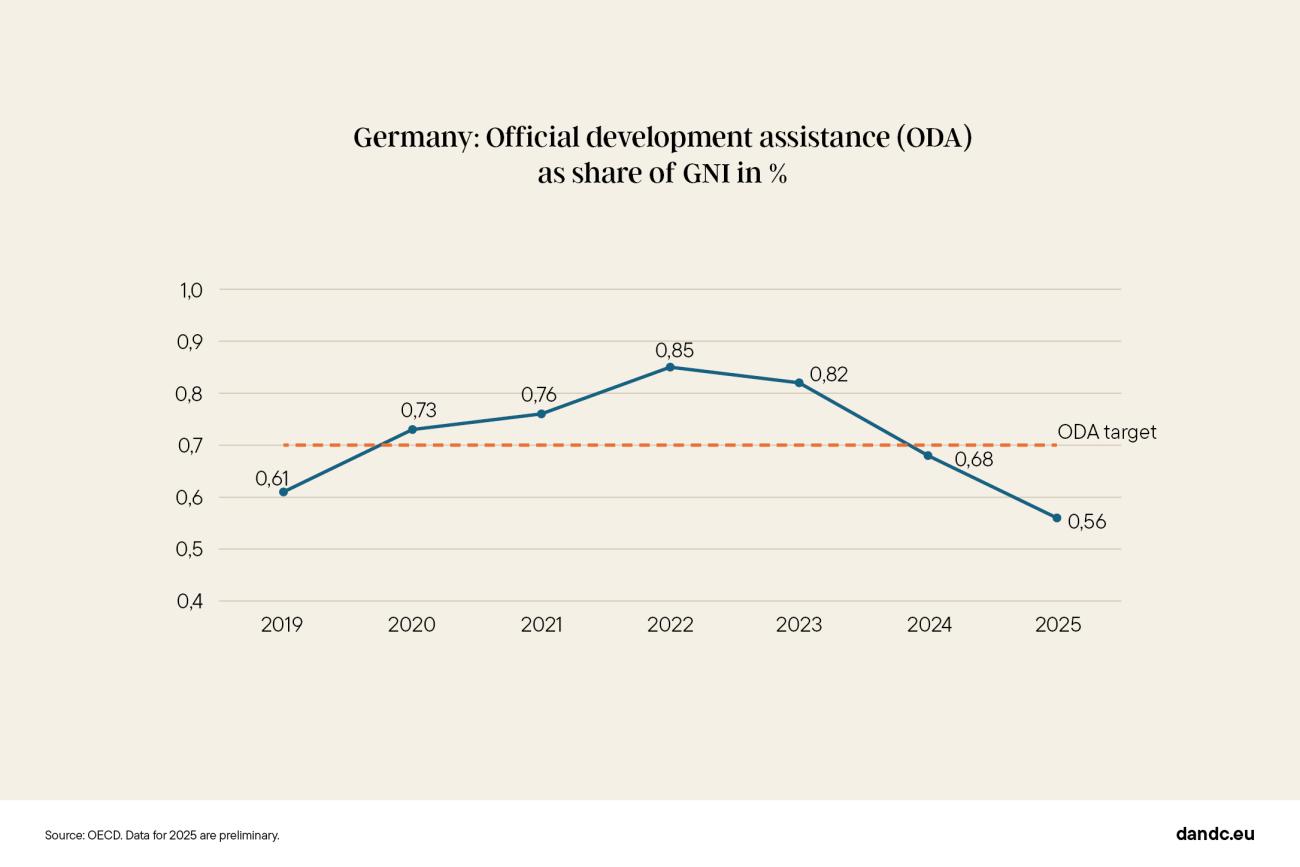
According to preliminary calculations, Germany spent 0.56 % of its gross national income on ODA in 2025. The so-called ODA ratio is therefore below the 0.7 % target that Germany and other Western industrialised countries have set. Germany’s ODA ratio has now fallen for three years in a row.
Majority of Germans in favour of development cooperation
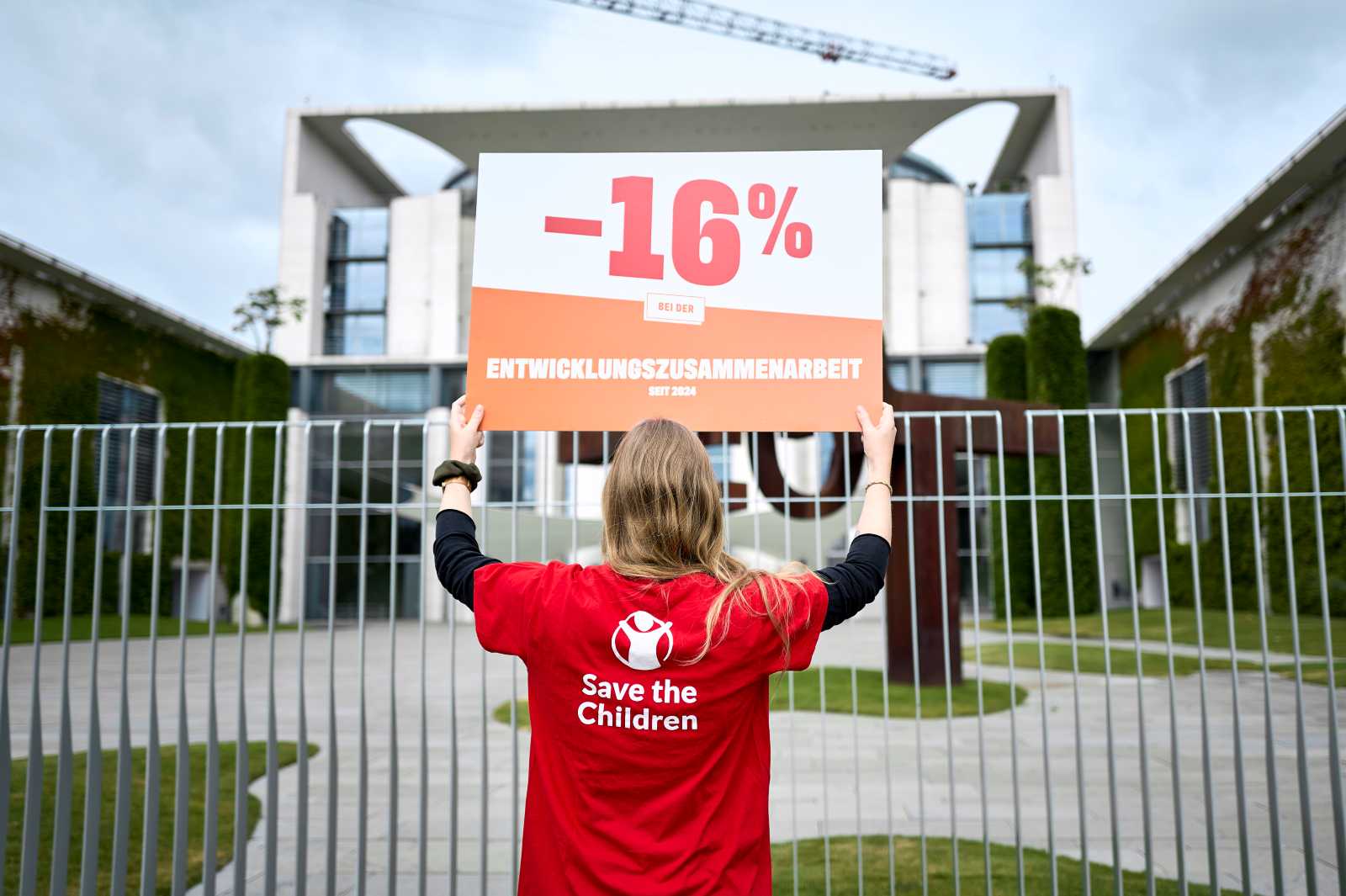
The financing of development policy has long been debated in Germany. The German Institute for Development Evaluation (DEval) regularly investigates Germans’ attitudes towards DC and their knowledge of DC-related subjects. The institute publishes its findings roughly every two years in the DEval Opinion Monitor, the most recent of which appeared in July 2026.
According to the Opinion Monitor, 68 % of Germans fundamentally support their country’s development policy; support for humanitarian aid is at 76 %. A survey in November 2025 revealed that 52 % of respondents were either in favour of current DC expenditures or wanted to increase them. From 2019 to 2022, this value was significantly higher, at approximately two-thirds. Compared to the low point in January 2024 (47 %), approval of German DC spending has recently been climbing.
The 2026 DEval Opinion Monitor also shows that:
- Germans systematically overestimate the share of Germany’s gross national income that goes to DC. Instead of the presumed 10 %, the actual figure was 0.56 % in 2025.
- Germans are not well informed about development cooperation successes. For example, 60 % of respondents believe that global poverty has increased since 1990. In fact, extreme poverty has significantly declined since then, from 44 % to 10 % of the global population. Germans also underestimate progress in educating girls, increasing global vaccination rates and fighting child mortality.
Important actors in government development cooperation
The BMZ, under the leadership of Reem Alabali Radovan (SPD), with headquarters in Bonn and Berlin, provides information on where German state DC funding flows in its transparency portal. The government carries out development projects through what are known as the implementing organisations of German development cooperation. These include:
- the Deutsche Gesellschaft für Internationale Zusammenarbeit (GIZ), which carries out or advises on development projects in approximately 120 countries around the world.
- the KfW Development Bank, which supports programmes and projects with loans or grants.
- the DEG – Deutsche Investitions- und Entwicklungsgesellschaft, which finances private companies and advises them on their planned investments in developing countries and emerging markets.
- Engagement Global, the central contact agency in Germany for development policy initiatives, which, among other things, provides information and education on global development and is also the publisher of D+C Development and Cooperation.
- the Federal Institute for Geosciences and Natural Resources (BGR), Germany’s national geological service, which carries out technical cooperation projects.
- the National Metrology Institute (PTB), which promotes the quality, safety and environmental sustainability of goods, services and processes at the international level.
The German Institute of Development and Sustainability (IDOS) is not an implementing organisation, but it is nevertheless an important institution of government development cooperation. IDOS conducts research, offers policy advice and facilitates knowledge cooperation and training.
The task of the aforementioned German Institute for Development Evaluation (DEval) is to evaluate German DC independently and scientifically.
In addition to these and other government development actors, numerous civil society organisations play an important role in German development cooperation, including multiple faith-based organisations. Approximately 150 civil society groups have joined together in the Verband Entwicklungspolitik und Humanitäre Hilfe deutscher Nichtregierungsorganisationen e. V. (VENRO).
The D+C editorial team
euz.editor@dandc.eu